
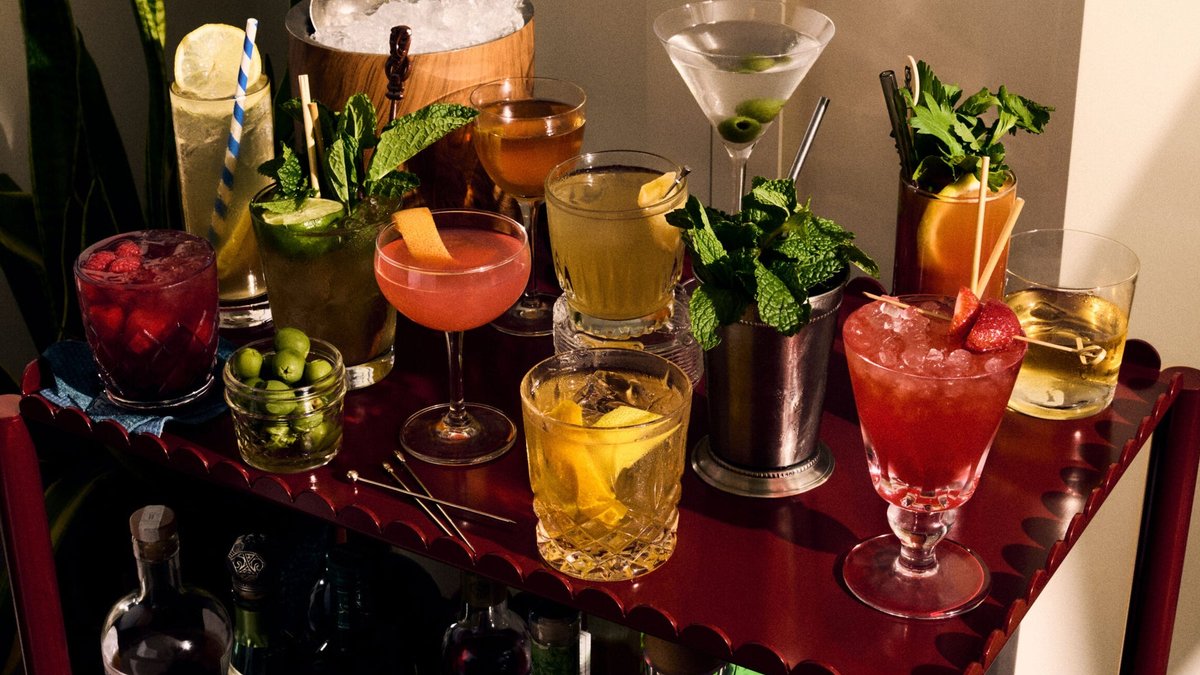
The U.S. celebration of its 250th anniversary this summer provides a unique lens to examine its history through beverages. These 12 drinks reveal America’s development—from colonial punch bowls to contemporary cocktail trends—each carrying traces of migration, hospitality, and cultural evolution.
A Colonial Worker’s Electrolyte Predecessor
Switchel was a field worker’s solution to staying hydrated while laboring under the heat of the sun. Crafted from apple cider vinegar, ginger, molasses, and water, its sharp, mineral-rich flavor made it essential during orchard work and field breaks. Though nonalcoholic by design, adding rum or apple brandy connected it to early American cider production—a key part of the orchard economy that shaped early American cider and apple spirits.
The drink’s practicality extended beyond agricultural fields. Tavern owners served switchel as a refreshing alternative to hard liquor, and its simplicity allowed for large-scale preparation. The recipe’s adaptability—whether consumed plain or spiked—demonstrates how American drinks adjusted to both survival needs and leisure pursuits.
Franklin’s Atlantic World in a Glass
Benjamin Franklin’s milk punch from 1763 addressed a critical challenge in early punch recipes: creating a drink that could travel and age without spoiling. His version combined brandy, milk, sugar, citrus, and spices, then strained it until the liquid clarified, producing a stable, delicate punch suitable for storage. The technique borrowed from British dairy drinks like syllabub but adapted to local ingredients.
The drink’s historical importance lies in its ingredients. French brandy represented transatlantic trade connections, while West Indian citrus and English dairy methods showcased colonial America’s ability to blend diverse traditions. Served at Philadelphia’s early Republic gatherings, it became a symbol of the young nation’s ambition, practical yet aspirational.
New Orleans’ French-Creole Fusion
The Sazerac represents New Orleans’ contribution to American drink culture, embodying the city’s complex identity. Emerging in the 19th century, it originally used cognac before switching to rye whiskey, a change reflecting the city’s economic and cultural shifts. The signature absinthe rinse enhances the whiskey’s character without overwhelming it, creating a balanced flavor profile.
New Orleans’ influence on the Sazerac extends beyond its recipe. The cocktail became a civic symbol, served in hotel bars and historic venues as a representation of Southern hospitality. Its development reflects the city’s role as a cultural crossroads, where French, Caribbean, and American traditions merged. Even the name, derived from the brandy Sazerac de Forges, highlights its transatlantic origins.
The Sazerac’s lasting appeal lies in its restraint. Unlike later cocktails that emphasized complexity, it achieves balance through spirit, sugar, bitters, and a subtle anise note from absinthe. This simplicity allowed it to endure through Prohibition and remain relevant in contemporary bars, appearing equally in tourist-friendly establishments and dimly lit speakeasies.
The Drink That Defined ‘Cocktail’
When the term “cocktail” entered American vocabulary in the early 1800s, the Old-Fashioned became its defining example. An 1806 newspaper described it as “a stimulating mixture of spirits, sugar, water, and bitters,” a description that perfectly matches the Old-Fashioned.
The drink’s evolution tracks broader changes in American tastes. Early versions used brandy, but bourbon and rye became dominant as whiskey production expanded in the Midwest and South. Wisconsin supper clubs, for instance, favored brandy versions, reflecting regional preferences. Despite these variations, the core ingredients, spirit, sugar, water, bitters, and citrus peel, remained constant, proving that minimalism could create enduring appeal.
How American Cocktails Got Their Edge
The Martinez sits at a critical point in the evolution of the American cocktail. Made with Old Tom gin, sweet vermouth, maraschino liqueur, and bitters, it appears somewhere between the Manhattan and the martini. Its ingredients reveal a different palate from the dry, austere drinks many people now associate with gin. Old Tom is rounder and lightly sweetened. Sweet vermouth carries weight. Maraschino liqueur adds perfume, texture, and faint bitterness. The Martinez shows how American cocktails moved from sweetened, aromatic, wine-influenced formulas toward the sharper, drier forms that would come to dominate the 20th century.
Brunch’s Most Adaptable Drink
The Bloody Mary stands as the ideal brunch companion, offering a savory, spicy, and infinitely customizable experience. While its origins are debated, often credited to French bartender Fernand Petiot, its rise in the U.S. reflects the country’s tradition of reinvention. The drink’s strength lies in its adaptability: gin creates a Red Snapper, tequila produces a Bloody Maria, and toppings range from celery salt to hot sauce.
What makes the Bloody Mary distinctly American is its regional flexibility. Southern versions tend to be lighter, with more citrus and less spice, while Midwestern variations incorporate hearty garnishes like bacon or pickles. Even the name evolves, Red Snapper in some bars, Bloody Bull with bull’s-eye garnishes, demonstrating how the drink absorbs local flavors while maintaining its core identity.
The Bloody Mary also embodies America’s preference for restorative beverages. Like coffee or oatmeal, it’s designed to revive rather than merely entertain. Its simple ingredients, tomato, vodka, spices, combine to create something greater than their individual parts. This quality explains why it remains the quintessential brunch cocktail, decades after its creation.
A Kentucky Derby Tradition with Hidden Labor History
The mint julep functions as more than a Kentucky Derby tradition, it represents a hospitality ritual. Early descriptions emphasize technique over exact measurements: proper mint crushing, ice building, and presentation. This focus on performance reflects the 19th century’s fascination with spectacle, when ice and sugar remained luxuries.
Related: The Science Behind Balanced Meal Prep Plans
The drink’s history reveals connections to Black bartenders and hospitality workers who shaped American drinking culture. Tom Bullock, author of The Ideal Bartender (1917), was among those who refined the julep’s preparation, ensuring both visual appeal and perfect balance. Their expertise transformed the drink into a symbol of Southern hospitality, even as it obscured the labor behind its creation.
Today, the julep’s association with the Derby often overshadows its broader cultural significance. Originally a year-round drink, not just a spring racing staple, its accessible ingredients, bourbon, mint, sugar, ice, made it popular in homes and taverns alike. This democratic appeal remains part of its charm, though modern versions frequently lean toward extravagance.
Tiki’s Rum, Fantasy, and Mid-Century Branding
The Mai Tai remains tiki’s most contentious classic, a drink simple in concept but endlessly debated in practice. Trader Vic’s version, built around Wray & Nephew Jamaican rum, became the industry standard, though its exact origins remain unclear. When that rum became unavailable, Vic developed proprietary blends to maintain its flavor, illustrating how branding shaped American drink culture.
The Mai Tai represents the convergence of rum, Caribbean ingredients, and mid-century escapism. Its balanced combination of rum, lime, curaçao, and orgeat aimed to evoke tropical paradise, even when the reality was far more ordinary. This disconnect contributes to its appeal: it allows drinkers to imagine escape, whether in Polynesian-themed bars or suburban backyards.
The Mai Tai’s influence extends to modern cocktails, with its layered flavors, sweet, sour, and herbal, paving the way for drinks like the Zombie and Piña Colada. Contemporary bartenders continue to debate its proportions, proving that the best cocktails remain open to interpretation. This quality cements its status as a touchstone for rum enthusiasts and tiki aficionados.
Red Drinks as Cultural Throughlines
Red drinks in America represent more than individual recipes, they form a tradition tracing back to West African bissap, Caribbean sorrel, and Mexican agua de Jamaica. These beverages, served at cookouts, church gatherings, and Juneteenth celebrations, carry memory and hospitality in every serving. The Homecoming variation, made with strawberries, raspberries, and black tea, preserves this tradition while adapting it to seasonal fruits.
These drinks hold cultural significance through their role in communal moments. A hibiscus-based sorrel at a Caribbean festival or a strawberry cordial at a Southern family reunion serves as more than refreshment, it preserves heritage. Adding rum, gin, or bourbon transforms them into cocktails, but the core purpose remains unchanged: celebration embodied in a glass.
Their flexibility ensures broad appeal. Served as nonalcoholic coolers or spiked cocktails, they adapt to any occasion. This versatility mirrors how American drink culture absorbs and reinterprets traditions from Africa, the Caribbean, and the American South. In this way, red drinks function as more than beverages, they represent a living archive of shared history.
The Modern Classic That Redefined Whiskey Cocktails
Sam Ross’s Penicillin, created at Milk & Honey in the mid-2000s, transformed whiskey cocktails by incorporating honey and ginger into a Whiskey Sour framework. The drink’s innovation lies in its layering: blended scotch forms the base, topped with a float of smoky single malt. This technique altered perceptions of texture and aroma, proving that subtle adjustments could transform classics.
Its restorative qualities, warming in winter, refreshing in summer, bridged old and new traditions. Unlike previous whiskey cocktails that leaned heavily toward sweetness or bitterness, the Penicillin balanced both elements, making it accessible to newcomers while satisfying whiskey enthusiasts. This equilibrium explains its central role in the modern cocktail revival.
The Penicillin’s impact extends beyond bars. It introduced many drinkers to scotch in an approachable yet exciting way. The honey and ginger softened the whiskey’s harshness, while the float added visual drama. In this manner, the Penicillin didn’t merely create a new cocktail, it reshaped how Americans viewed whiskey in mixed drinks.
Tequila’s Aperitivo Revival
Katie Stipe’s Siesta, invented in 2006, moved tequila beyond margaritas by blending it with Campari, lime, grapefruit, and simple syrup. The result combined elements of a daiquiri, margarita, and aperitivo, capturing the essence of the modern cocktail movement.
The Siesta’s distinction lies in its balance. Campari provides bitterness, grapefruit offers brightness, and tequila grounds the mixture. This harmony made it appealing to casual drinkers while giving bartenders creative freedom. Its success reflected a broader shift in American tastes, away from sweet, fruity cocktails toward drinks with structure and complexity.
The Siesta’s influence appears in later cocktails like the Paper Plane, which also emphasizes bittersweet profiles. By demonstrating tequila’s potential beyond margaritas, the drink helped redefine an entire category. Today, it remains popular in bars that blend tradition with innovation, a perfect example of how American cocktails continue to evolve.


